임베디드 스마트 포인터 선택 — unique·shared·custom 비교
#한 줄 요약
“임베디드에서는
unique_ptr이 기본입니다.”shared_ptr은 거의 피하고, raw pointer는 non-owning 참조에만 씁니다.
#어떤 문제를 푸는가
C++의 스마트 포인터 세트는 다음과 같습니다.
- **
unique_ptr<T>**는 단일 소유를 표현하며 RAII로 자동 해제합니다. - **
shared_ptr<T>**는 공유 소유를 표현하며, 참조 계수를 스레드 안전하게 갱신합니다. - **
weak_ptr<T>**는 shared의 non-owning 참조입니다. - **raw pointer(
T*)**는 non-owning이며 소유권을 갖지 않습니다.
각각을 임베디드에서 언제 쓸지 정리합니다.
#unique_ptr<T> — 단일 소유
#include <memory>
std::unique_ptr<Sensor> sensor = std::make_unique<Sensor>();// sensor가 유일한 owner// 소멸 시 자동 delete
// 이동 가능auto other = std::move(sensor); // sensor → other로 소유권 이전// sensor는 이제 nullptr기본 deleter는 빈 타입이라 공간을 차지하지 않습니다. 64비트 호스트에서 sizeof(std::unique_ptr<int>)는 libstdc++·libc++ 모두 8바이트, 즉 포인터 하나였습니다. 표준이 이 크기를 보장하지는 않으며, 상태 있는 deleter는 그만큼 크기를 늘립니다(Part 2-02의 크기 표).
#임베디드 활용
class Driver {public: static std::unique_ptr<Driver> create(int param) { if (!validate(param)) return nullptr; return std::make_unique<Driver>(param); }};
void setup() { auto driver = Driver::create(42); if (driver) { driver->initialize(); // ... 사용 // 함수 끝 — 자동 delete }}RAII와 명시적 소유권을 제공합니다. make_unique는 할당 실패를 nullptr로 바꾸지 않습니다. 복구 가능한 OOM이 필요하면 예외 정책에 맞는 nothrow factory나 pool API를 별도로 설계합니다.
#Custom deleter — pool 활용
struct PoolDeleter { Pool* pool; void operator()(uint8_t* p) const { if (p) pool->deallocate(p); }};
using PoolPtr = std::unique_ptr<uint8_t, PoolDeleter>;
PoolPtr alloc(Pool& p, size_t n) { return PoolPtr(p.allocate(n), {&p});}heap을 전혀 쓰지 않고 pool에서 할당한 뒤 자동으로 해제합니다.
#shared_ptr<T> — 공유 소유
auto a = std::make_shared<Resource>();auto b = a; // copy — 카운터 증가 (atomic)// a와 b 모두 owner — 마지막이 사라질 때 deleteshared_ptr은 객체 포인터와 control block 포인터를 저장합니다. 64비트 호스트에서 sizeof(std::shared_ptr<int>)와 sizeof(std::weak_ptr<int>)는 libstdc++·libc++ 모두 16바이트였습니다. 이 글의 ARM 툴체인에는 libstdc++가 없어 32비트 크기는 재지 못했습니다.
control block은 객체와 수명이 다른 관리 정보입니다. make_shared는 객체와 control block을 한 번에 할당하고, shared_ptr<T>(new T)는 두 번 할당합니다(호스트 g++-16에서 operator new 호출 1회 대 2회, Part 1-01). 표준이 고정 레이아웃을 정하지는 않지만 다음 정보가 들어갑니다.
- strong과 weak 두 개의 atomic 카운터
- deleter
- allocator
- 구현별 관리 정보와 정렬 공간
#임베디드에서의 문제
- 복사·소멸마다 참조 계수를 갱신합니다. libstdc++는 이 갱신을
__gnu_cxx::__exchange_and_add_dispatch로 하며, 스레드가 활성이면 원자 연산을 씁니다(Part 1-01). 여러 코어가 같은 카운터를 갱신하면 그 캐시 라인을 코어끼리 주고받습니다. - control block이 heap을 사용합니다(
make_shared는 1번, 별도new는 2번 할당). - cyclic reference에서
weak_ptr을 쓰지 않으면 leak이 발생합니다. 아래 함정 4에서 실행해 봅니다.
공유 수명 관리가 필요한지 먼저 확인합니다. control block의 thread safety는 pointee 데이터의 thread safety가 아니며, 같은 shared_ptr 객체의 동시 변경도 별도 동기화가 필요합니다.
#마지막 소유권을 놓는 실행 문맥
일반적인 shared_ptr의 마지막 strong owner를 해제하는 경로에서 deleter가 실행됩니다. 생성한 task와 같은 task에서 소멸한다고 가정하면 안 됩니다. 소멸자·custom deleter의 lock·할당 해제·장치 종료 비용과 허용 문맥을 확인하고, 실시간 task나 ISR에서 마지막 owner가 사라질 수 있는 설계는 별도로 검토합니다. reference count가 안전하다는 사실은 이 정리 비용의 상한이나 ISR 안전성을 보장하지 않습니다.
weak_ptr::expired()를 확인한 뒤 raw pointer를 쓰는 것은 수명 확보가 아닙니다. 아래처럼 lock()으로 얻은 strong owner를 실제 사용이 끝날 때까지 유지합니다. 별도 동기화가 없는 pointee의 동시 변경도 여전히 금지됩니다.
#shared_ptr이 정말 필요한 경우
- 여러 owner가 진짜로 필요해서 한 명의 owner로 표현이 어려운 경우
- 서로 다른 task가 독립적으로 객체의 수명을 연장해야 하는 경우
- 비동기 callback에서 객체 lifetime을 보장해야 하는 경우
class Job { std::shared_ptr<Data> data_;public: Job(std::shared_ptr<Data> d) : data_(std::move(d)) {} void execute() { // data_가 다른 task에서도 사용 중 process(*data_); }};#weak_ptr<T> — non-owning 관찰
auto strong = std::make_shared<Resource>();std::weak_ptr<Resource> weak = strong;
// 사용if (auto locked = weak.lock()) { // strong 유효 — locked가 잠시 owner} else { // strong 이미 해제됨}cyclic reference를 회피할 때 씁니다.
struct Parent { std::vector<std::shared_ptr<Child>> children;};
struct Child { std::weak_ptr<Parent> parent; // shared 아님 — cycle 방지};weak_ptr은 shared_ptr이 만든 control block을 가리키므로 shared_ptr 없이 쓸 수 없습니다(크기도 포인터 두 개, 16바이트). heap을 피하는 설계라면 둘을 함께 피합니다.
#Raw pointer — non-owning
class Cache {public: void register_handler(Handler* h) { // non-owning handler_ = h; }
void on_event() { if (handler_) handler_->handle(); }
private: Handler* handler_ = nullptr;};
Handler h;cache.register_handler(&h); // 소유권 이전 X — h는 호출자가 관리raw pointer는 non-owning reference 역할만 하며, 소유자는 따로 둡니다.
C++ Core Guidelines의 권장은 다음과 같습니다.
- Owning pointer는
unique_ptr이나shared_ptr로 표현합니다. - Non-owning pointer는 raw
T*나 referenceT&로 표현합니다.
C++ Core Guidelines의 gsl::owner<T*> 마커로 의도를 명시할 수도 있습니다.
#결정 트리
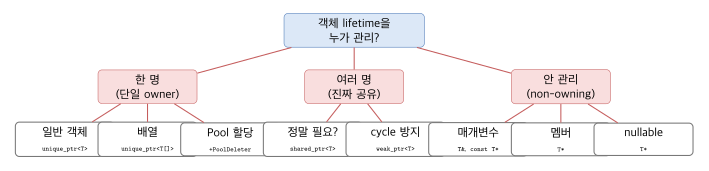
소유자가 하나로 정해지면 unique_ptr, 소유하지 않는 접근이면 raw 포인터·참조입니다. shared_ptr은 “마지막 사용자가 누구인지 실행 전에 알 수 없다”는 조건이 있을 때만 남습니다.
#임베디드 패턴 — Factory + unique_ptr
class Device { Device() = default; // private
public: static std::unique_ptr<Device> create(const Config& cfg) { if (!validate(cfg)) return nullptr;
auto d = std::unique_ptr<Device>(new Device); if (!d->initialize(cfg)) return nullptr; return d; }};
// 사용auto device = Device::create(my_config);if (!device) { log_error("device create failed"); return;}
device->run();// 자동 cleanup생성 실패 처리, RAII, 명시 소유를 한 번에 해결합니다.
#임베디드 패턴 — Optional 멤버 with unique_ptr
class System { std::unique_ptr<Logger> logger_; // nullable
public: void enable_logging() { logger_ = std::make_unique<Logger>(); }
void log(const char* msg) { if (logger_) logger_->write(msg); }};logger가 있을 수도 없을 수도 있는 상황에서 동적으로 활성화합니다.
대안은 heap을 쓰지 않는 std::optional<Logger>입니다.
class System { std::optional<Logger> logger_; // Logger 내부 저장; Logger 자체 할당은 별도
public: void enable_logging() { logger_.emplace(); }};logger_가 내부에 Logger 객체를 직접 저장하므로 heap을 쓰지 않습니다. 대신 Logger를 쓰지 않을 때도 System 안에 sizeof(Logger)와 플래그만큼 공간을 차지합니다. unique_ptr 쪽은 포인터 하나만 차지하고 Logger는 heap에 둡니다.
#자주 보는 함정과 안티패턴
#1. new 직접 사용
auto* p = new Foo(); // raw owning pointer — 어떻게 delete?일반 생성은 make_unique를 우선합니다. private 생성자에 접근하는 클래스 내부 factory나 nothrow 할당처럼 직접 new가 필요한 경우에는 즉시 owner로 감쌉니다.
#2. shared_ptr 무심코 사용
shared_ptr<Data> get_data(); // 정말 공유 소유?unique_ptr로 충분하면 unique로 갑니다. shared는 정당화가 필요합니다.
#3. unique_ptr의 함수 포인터 deleter
std::unique_ptr<FILE, decltype(&fclose)> f(fopen(...), &fclose);함수 포인터 deleter는 포인터를 하나 더 저장합니다. 64비트 호스트에서 8바이트가 16바이트가 됐습니다(Part 2-02). 상태가 필요 없다면 빈 functor deleter를 씁니다.
#4. weak_ptr 없이 cycle
struct A { shared_ptr<B> b; };struct B { shared_ptr<A> a; }; // cycle — 영원히 안 해제생성자·소멸자에서 살아 있는 객체 수를 세는 두 구조체를 make_shared로 만들어 서로 가리키게 한 뒤 scope를 벗어나면, g++-16·Clang 23.1.5 모두 살아 있는 객체가 2였습니다. B → A를 weak_ptr로 바꾸면 0이었습니다. 한쪽을 weak_ptr로 둡니다.
#5. unique_ptr copy 시도
auto a = std::make_unique<Foo>();auto b = a; // ERROR — copy 안 됨아래 예제의 -DCOPY_OWNER 빌드에서 g++-16은 error: use of deleted function 'std::unique_ptr<_Tp, _Dp>::unique_ptr(const std::unique_ptr<_Tp, _Dp>&)', Clang 23.1.5는 error: call to implicitly-deleted copy constructor of 'std::unique_ptr<Resource, CountDelete>'를 냈습니다. move를 씁니다(auto b = std::move(a);).
#6. shared_ptr atomic overhead 무시
복사·소멸마다 참조 계수를 갱신합니다. 함수 인자를 shared_ptr<T> 값으로 받으면 호출마다 복사가 일어나므로, 소유권을 넘기지 않는 함수는 T&나 T*로 받습니다(C++ Core Guidelines F.7). 이 글에서는 갱신 비용을 cycle로 재지 않았습니다.
#실행 확인 — 해제 횟수와 공유 수명
다음 독립 파일은 custom deleter의 해제 횟수, unique 소유권 이동, weak 관찰의 만료를 검증합니다. Homebrew Clang 23.1.5와 g++-16 모두 ASan·UBSan으로 exit 0이었습니다. 시간·cycle 비교는 하지 않았습니다.
#include <cassert>#include <memory>struct Resource { static inline int live = 0; Resource() { ++live; } ~Resource() { --live; }};struct CountDelete { int* released; void operator()(Resource* p) const noexcept { ++*released; delete p; }};int main() { int released = 0; { std::unique_ptr<Resource, CountDelete> first(new Resource, {&released});#ifdef COPY_OWNER auto copy = first;#endif auto second = std::move(first); assert(!first && second && Resource::live == 1); second.reset(); assert(Resource::live == 0 && released == 1); } assert(released == 1); std::weak_ptr<Resource> observer; { auto owner = std::make_shared<Resource>(); observer = owner; auto pin = observer.lock(); owner.reset(); assert(pin && !observer.expired() && Resource::live == 1); } assert(observer.expired() && Resource::live == 0);}heap 금지 설계에서는 이 heap 기반 실험을 그대로 채택하지 말고 Part 3-03의 pool 계약과 deleter를 조합합니다.
#직접 reference counting을 만들기 전의 계약
Intrusive reference count는 객체에 카운터를 넣는 방식입니다. 초기 count=1인 객체를 포인터 생성자에서 다시 add_ref하면 한 번의 release 뒤 count가 1로 남을 수 있습니다. adopt와 retain 생성 경로를 구분하거나 count=0에서 첫 owner가 증가시키도록 계약을 정해야 합니다.
copy는 add_ref, move는 증가 없이 이전, 소멸은 release이며 대입·자기 대입·빈 상태까지 구현해야 합니다. delete this를 쓸 객체는 그 delete 정책과 맞게 생성되어야 하며 stack·pool 객체를 같은 경로로 해제하면 안 됩니다. 카운터를 atomic으로 바꾸는 것만으로 객체 데이터·회수 프로토콜·overflow·ISR 안전성까지 해결되지 않습니다. 이 장은 불완전한 intrusive pointer를 완성 구현으로 제시하지 않습니다.
#정리
- 임베디드에서는
unique_ptr이 기본입니다. 기본 deleter로는 포인터 하나 크기(측정 8바이트, 64비트 호스트)로 명시적 소유와 RAII를 제공합니다. shared_ptr은 회피합니다. atomic 카운터와 heap 위의 control block이 부담입니다.- raw pointer는 non-owning에만 쓰고 소유권은 항상 unique나 shared로 표현합니다.
- Custom deleter(struct나 lambda)로 pool, FD, 비-heap 자원을 관리합니다.
std::optional<T>는 T를 내부에 저장하지만 T가 만드는 추가 할당까지 없애지는 않습니다.
#근거와 검증 범위
2026-11-16에 smart-pointers.cpp, 순환 참조·sizeof 시험을 Homebrew Clang 23.1.5(libc++)와 g++-16(libstdc++)으로 macOS arm64 host에서 실행했습니다. 보드 실행·32비트 크기·cycle 측정은 하지 않았습니다. 다른 이름 없는 코드 블록은 주변에 정의한 장치 API를 가정하는 부분 예제이며 하나의 translation unit으로 합치지 않습니다.
#관련 항목
- Part 2-01: RAII 기초
- Part 2-02: RAII 실전 패턴 — custom deleter
- Part 3-03: Pool Allocator — pool + unique_ptr
- Part 3-10: 소유권 모델
- C++ Core Guidelines R.20–R.24
#다음 글
Part 3-10: 소유권 모델 — 객체 lifetime에 책임을 명확히 할당하는 owner, observer, borrower 모델을 다룹니다.
Embedded C++ for Real Systems · 28 of 41 전체 목차 접기
- 1 Embedded C++ for Real Systems — 임베디드 모던 C++ 시리즈 소개
- 2 임베디드 C++ vs C — 런타임·코드 크기·ABI 관점 비교
- 3 임베디드 C++ 컴파일러 플래그 분석 — -fno-rtti·-fno-exceptions·-Os
- 4 임베디드 C++ 런타임 요구사항 — libstdc++·newlib·crt0 분석
- 5 C++ 코드 크기 분석 — 가상 함수·템플릿·예외 비용 추적
- 6 C++ ABI 호환성 — Itanium ABI·name mangling·vtable 레이아웃
- 7 C++ 스타트업 코드 분석 — .init_array·전역 생성자 호출 순서
- 8 임베디드 C++ 링커 스크립트 — vtable·정적 객체 배치 추적
- 9 임베디드 C++ 표준 선택 가이드 — C++11/14/17/20/23 트레이드오프
- 10 임베디드 RAII 기초 — 리소스 안전성과 결정적 소멸 보장
- 11 임베디드 RAII 실전 패턴 — Lock·Pin·DMA·Power 관리
- 12 constexpr 기초와 임베디드 적용 — 컴파일 타임 계산 활용
- 13 constexpr 고급 활용 — 정렬 테이블·검색·해시 컴파일 타임 생성
- 14 consteval과 constinit 분석 — C++20 컴파일 타임 강제 메커니즘
- 15 임베디드 Templates 기초 — 타입 안전과 코드 재사용 분석
- 16 Template 비용 분석 — 코드 폭증·인스턴스화·디버그 정보 측정
- 17 CRTP 패턴 분석 — vtable 없는 정적 다형성
- 18 Type Traits 임베디드 활용 — SFINAE·is_pod·컴파일 타임 검사
- 19 C++20 Concepts 활용 — 템플릿 제약과 가독성 개선
- 20 동적 할당 없는 임베디드 C++ — placement new·정적 객체·풀
- 21 Custom Allocator 기초 — std::allocator 인터페이스 분석
- 22 Pool Allocator 구현 — Fixed-Size Block과 O(1) 보장
- 23 std::pmr 임베디드 활용 — Polymorphic Memory Resource 분석
- 24 No-Exception C++ 설계 — 코드 크기·결정성 트레이드오프
- 25 임베디드 에러 처리 패턴 — Result 전파·재시도·복구 정책
- 26 std::expected 분석 — C++23 결과 타입과 에러 전파
- 27 No-RTTI C++ 설계 — dynamic_cast 제거와 정적 타입 분기
- 28 임베디드 스마트 포인터 선택 — unique·shared·custom 비교
- 29 임베디드 C++ 소유권 모델 — single·shared·borrow 패턴
- 30 Intrusive Containers 분석 — 동적 할당 없는 컨테이너 설계
- 31 ETL 라이브러리 분석 — Embedded Template Library의 STL 대체
- 32 임베디드 Lock-free 기초 — atomic·memory ordering·CAS
- 33 Lock-free Container 구현 — SPSC Queue·Ring Buffer
- 34 Type-safe Flags 패턴 — Enum Class·Strong Typedef·Tag
- 35 임베디드 State Machine 패턴 — Variant·Visitor·Table-driven 비교
- 36 Compile-time FSM 구현 — 템플릿으로 상태 전이 검증
- 37 Singleton 대안 패턴 — Service Locator·Static Init·Phantom
- 38 MMIO Register 추상화 — 타입 안전한 비트 필드 접근
- 39 GPIO 추상화 패턴 — Template·Concept으로 보드 독립성
- 40 Peripheral 추상화 — UART·SPI·I2C 공통 인터페이스 설계
- 41 임베디드 HAL 설계 패턴 — Static·Dynamic·Hybrid 비교